
An online platform built entirely around games and interactive experiences made with artificial intelligence has crossed a notable milestone. Astrocade, a free website where anyone can generate playable content and share it with others, now reports 10 million monthly users.
The figure comes from CEO Amir Sadeghian, who discussed the platform’s growth in an interview with Gamesbeat. According to him, Astrocade doubled its audience in a relatively short window, climbing from roughly five million monthly users to 10 million over the past four months. That pace suggests a sizable appetite for AI-assisted entertainment, even as critics continue to question the quality of such output.
How the platform works
Astrocade’s pitch is simple enough. The tools are designed so that almost anyone can put together a game or an interactive experience, and everything created on the site can be opened and played by other visitors. The closest comparison is Roblox, where user-made content forms the backbone of the entire ecosystem.
Sadeghian argues that his company’s edge lies in the data it collects from end to end. Because Astrocade handles creation, distribution and recommendations all in one place, it can train its models on signals that stretch from the moment a game is made to the moment a player finds it enjoyable. In his view, that feedback loop gives the platform an advantage over rivals that only handle part of the process.
What is actually popular
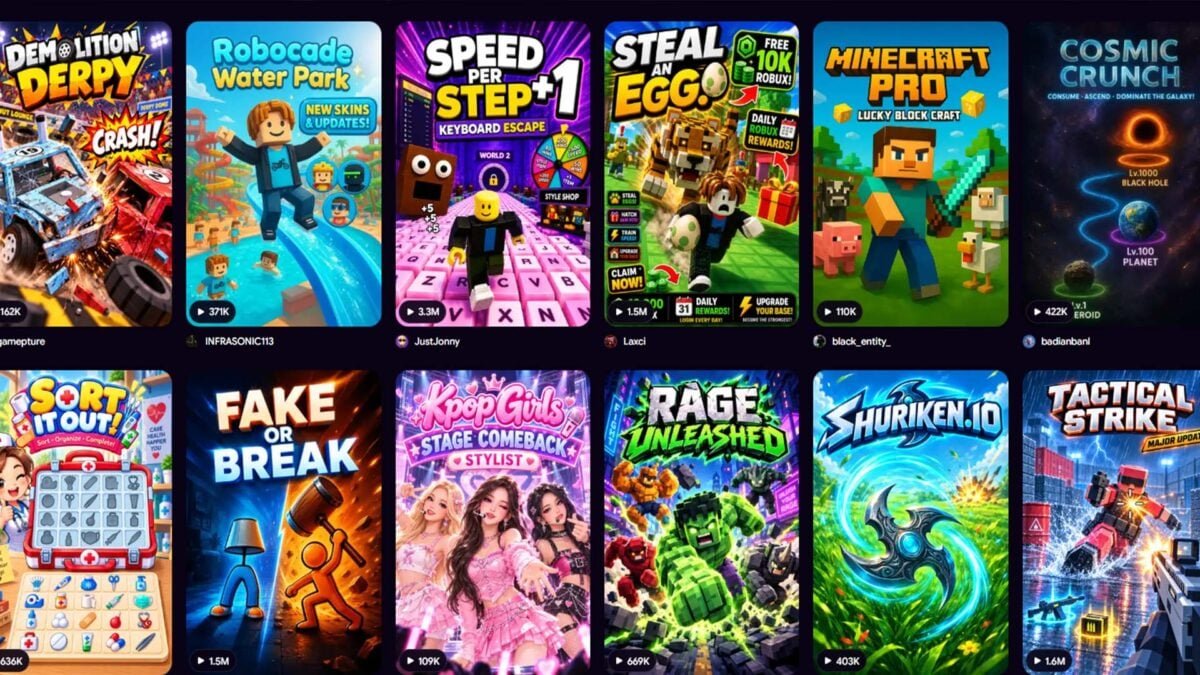
A quick look at the trending titles reveals a familiar pattern. Plenty of the most-played offerings are Minecraft lookalikes, productions featuring copyrighted characters, and copies of hit Roblox games. The artwork on many of them bears the hallmarks of AI generation, and the overall impression is less polished than what established studios produce.
None of that appears to have slowed adoption. Some of the site’s biggest attractions have racked up hundreds of thousands or even millions of plays, which indicates that users are far more interested in quick, familiar fun than in technical refinement.
A feed instead of a library
The delivery method also sets Astrocade apart. Its content is presented in a vertical format and served through an endless, algorithm-driven feed, mirroring the way short video apps keep viewers scrolling. Rather than browsing a catalogue, players swipe from one item to the next.
Sadeghian resists calling these items games at all. He prefers the term playables, framing them as something closer to social media posts that happen to be interactive. The roadmap includes educational material, AI companions and interactive stories, though what actually gets built will ultimately depend on the creators using the tools.
That raises an interesting question about incentives. Astrocade pays users more when their content performs well, which naturally pushes people toward proven formulas. Expecting a wave of thoughtful historical lessons seems optimistic when a knock-off of a popular Roblox hit is likely to draw a bigger crowd and a bigger payout.
The blur between AI and human work
Sadeghian maintains that the technology has improved to the point where detection is genuinely difficult. In his words, AI now writes code better than many engineers, and the 3D assets it produces are increasingly hard to tell apart from handcrafted ones. That claim cuts both ways: it speaks to rapid progress, but it also suggests a future where audiences may not know or care who or what made what they are watching.
Meanwhile, the company is getting ready to release an iOS app and is putting marketing money into the United States. Interestingly, the CEO notes that Astrocade is already popular there without any major push to grow that audience.
Whether the platform matures into something more than a stream of derivative content remains to be seen. For now, 10 million monthly visitors suggest that a large number of people are happy to scroll, tap and play whatever the algorithm serves up next.
Source: Kotaku