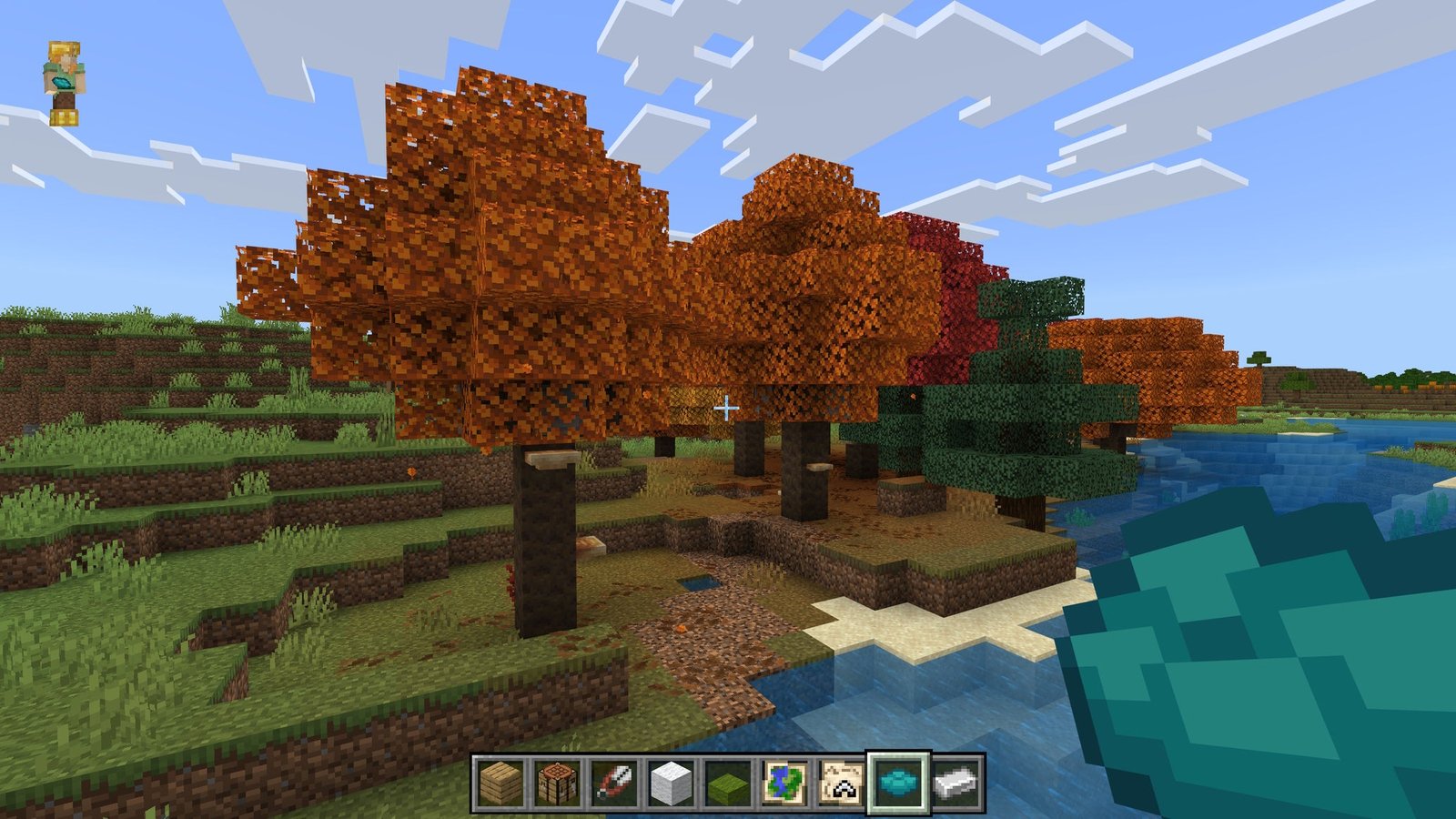
Minecraft’s Wilderness Bound update brought a handful of new places to poke around in, and among them is the Dappled Forest, a woodland defined by warm reds, oranges and earthy greys. It is also, frustratingly, one of the harder biomes to actually stumble across. Depending on the seed you are playing and where your spawn point happens to sit, you could wander for hours before the first poplar comes into view.
That rarity is part of the appeal for some players, but it does make planning a build around the biome’s autumn palette something of a chore. The good news is that the Dappled Forest follows a few loose rules about where it generates, and once you understand those, your search becomes a lot less random. The better news is that every block and plant you pull out of one keeps its colour no matter where you take it, so a desert base can look like a New England October if you want it to.
Where Dappled Forests Actually Spawn
There is no single coordinate formula that guarantees a Dappled Forest. What exists instead is a set of tendencies. The biome will not generate directly beside other wooded biomes, so if you are standing in a regular forest, a birch grove or a taiga, the next patch of trees over will not be a Dappled Forest. That rule alone rules out a lot of easy searching.
Beyond that, Dappled Forests skew toward colder climates and toward highland terrain. If your world has snowy plains, windswept hills or mountain ranges nearby, those are the neighbourhoods worth combing through first. Checking the area around a chilly biome is a much better use of time than sprinting across a jungle.
Something else worth knowing: these biomes come in wildly different sizes. Some are substantial groves that take a minute or two to walk across. Others are absurdly small, essentially a strip of brown grass and a couple of trees clinging to a riverbank. A biome that tiny is easy to walk straight past, which is a large part of why players report such trouble finding one. In testing across two separate worlds, it took several hours of bouncing between candidate regions before a Dappled Forest turned up at all, and the one that finally appeared was a modest patch at best.
How to Tell You Are Getting Close
Every Dappled Forest contains at least one poplar tree, and poplars are hard to mistake for anything else. Their leaves carry a deep red and orange colouring that sits in sharp contrast to the greens, browns and whites around them. Even a biome with only two or three trees will read as an obvious splash of colour against the landscape.
Because of that contrast, the practical approach is to gain altitude. Climb a hill or a mountain, or build a quick pillar, and scan the horizon for warm-toned foliage. Rivers and coastlines are also useful landmarks, since some of the smallest Dappled Forests hug the water’s edge.
There is one shortcut, though it depends entirely on luck. Loot from an Abandoned Camp can occasionally include a map that points toward a Dappled Forest. It is not a reliable method, and it only turned up once during testing, but if you happen to have one sitting in a chest, it is worth reading before you set off on foot.
What You Will Find Inside One
The headline feature is the poplar tree itself, and it is a good one for builders. Chopping the trunk yields Poplar Wood, a new block with a muted, earthy grey tone that pairs well with stone, deepslate and darker timber. It is a softer, cosier look than oak or spruce, and it works just as well for interior panelling and beams as it does for exterior walls.
Breaking the leaves of a poplar drops Poplar Saplings. These are more useful than a typical sapling drop, because planted poplars keep the biome’s colouring wherever they grow. You can raise a small grove of them beside a base in a savanna or on a beach and it will look exactly as it would in the wild. The same applies to the low red shrubs that sprout across Dappled Forest ground, which means the whole colour scheme is portable.
Shelf Mushrooms and Their Odd Extra Use
Growing on poplar trunks, both standing and fallen, are Shelf Mushrooms. Visually they are a nice detail, the sort of thing that makes a build look established rather than placed, but they do more than sit there. They function as bouncy platforms, letting you hop off them the way you would a slime block.
That makes them handy for a few practical tricks. A cluster of Shelf Mushrooms at the bottom of a cliff gives you a soft landing. Arranged in a column, they become a crude elevator. Placed around a base, they are a harmless bit of furniture that happens to double as a trampoline. It is a small mechanical quirk rather than a headline feature, but it gives the biome one thing to do beyond look pretty.
Fallen poplars are worth mentioning separately. They are a natural decoration the biome generates on its own, and dismantling one gives you a decent stack of wood without the effort of felling a standing tree. If you are gathering Poplar Wood for a project, hunt for the fallen trunks first.
Is the Trip Worth It?
Honestly, the Dappled Forest is mostly an aesthetic biome. It does not hide a unique ore, it does not gate a boss, and it does not hand out anything you cannot build around with existing materials. The poplar wood and the red shrubs are lovely, but the vibe is the product. If warm autumn tones are not something you care about in a build, you are not missing a great deal by skipping the search and getting on with something else.
If they are, though, the payoff is real. A Dappled Forest is an excellent place for a woodland cabin, a lakeside camp or a village project, and because the saplings and shrubs transplant perfectly, you can capture the look once and reuse it forever. That takes a lot of pressure off finding the perfect spot — you can collect a few saplings, walk away and recreate the biome wherever you actually want to live.
The search itself is the only real obstacle. Stick to cold regions and higher ground, watch for that unmistakable red canopy, and accept that you may need to cover serious distance before anything turns up. Take a couple of spare maps, set up a temporary bed along the way, and treat the hunt as a trip rather than a chore. When a tiny strip of brown grass and a single poplar finally appears on the horizon, it will feel earned.
Media
Source: Rock Paper Shotgun GUIDES